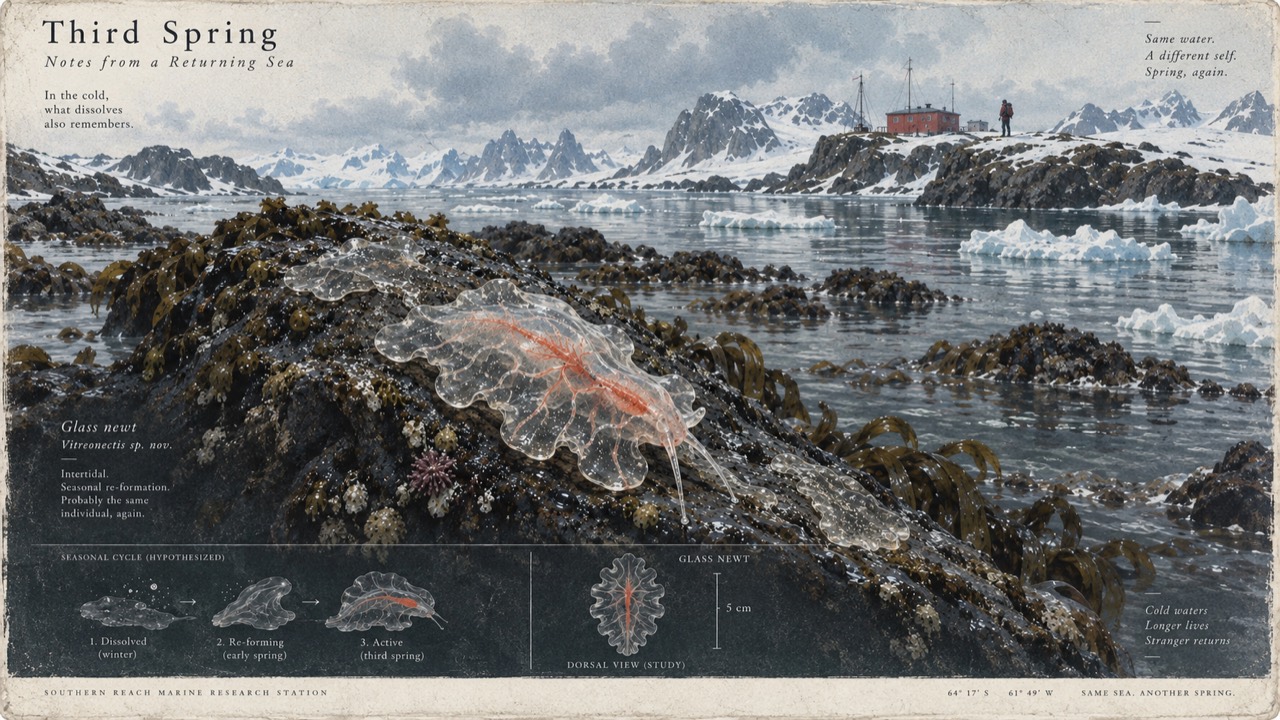
For nine months of the year, Astrid Station, at fifty-four degrees south, did not resemble a place suited to long-term human habitation. In winter, winds could remain above eighty kilometres an hour for weeks. The research building stood only sixty metres from the dormitory, yet people often had to pull themselves between the two along a fixed rope. Summer was somewhat better. A ring of dark blue water emerged around the coast, broken ice withdrew seaward, penguins reclaimed the dock, and the station’s residents resumed activities that made sense only when the weather was normal: washing windows, repairing roofs, and discussing the following year’s budget.
The glass newt was discovered during one such summer.
It was not a newt. It was not even a vertebrate. Andreas, the postdoctoral researcher who first found it, merely thought the pale red digestive tubes inside its transparent body resembled those of a larval amphibian, and the name stayed. An adult glass newt was about the length of a hand. They lived in a rock pool north of the station that could be entered only at low tide. They moved slowly, ate algae, and appeared to possess nothing that might excite an international journal—until the first winter observation began.
At the end of May, the temperature of the pool fell below freezing. The researchers expected the glass newts to enter dormancy. Instead, they began to come apart.
Not decay in the sense of death. Their bodies gradually lost structure from the edges inward. Over roughly forty-eight hours, muscle, digestive organs, and neural tissue became a nearly transparent gel, leaving only a thin film attached to the rock. All winter the pool appeared empty. When the water warmed the following October, cells began differentiating within the gel again. New digestive tubes, tentacles, and ganglia formed. A few weeks later, a group of glass newts—roughly equal in number and similar in size to the previous year’s—were crawling over the rocks once more.
The phenomenon was strange enough by itself. What caused the real trouble was the behavioural experiment.
The previous summer, Mira, the station’s behavioural ecologist, had trained one glass newt to navigate a simple Y-shaped tank. Food was placed on the left; the right side held nothing. After a dozen or so trials, the animal reliably chose the left arm. Following standard practice, she marked its transparent back with a tiny dot of nontoxic blue pigment and assigned it the number A17.
In winter, A17 turned to gel with the others.
The blue dot was, of course, gone the following spring. The body had been completely rebuilt; not even the old skin existed. Out of curiosity, Mira randomly collected twelve of the newly emerged glass newts and placed them in the old tank.
On its first test, one of them went directly to the left.
On the second, it chose left again.
Twelve trials in a row, without a single error.
Mira wrote only one sentence in the experimental record: “Residual odour must be ruled out.”
They replaced the tank entirely, moved the experiment to another building, redesigned the maze, and switched the food to the opposite side. The animal continued to display traces of learning that should have appeared only after training.
Chen Xiuyuan, who led the molecular group, insisted this did not show that the animal was A17. The basal gel retained after disintegration might carry some form of biochemical memory, he said, something like a long-term immune state. But that was entirely different from being “the same individual.” Mira asked what the difference was. Chen said, “If you burn a book and another book with the same contents grows out of the ashes, it is not the same book.”
Eve, the station director, was filling out the second year’s budget application. Without looking up, she said, “As long as the foundation considers it the same book.”
The question began as a lunchtime joke. By the third year, it had become the most expensive question at the entire station.
The team confirmed that the glass newts retained more than simple conditioned responses. Some remembered particular geometric forms they had encountered the year before. They avoided mechanical devices that had once delivered a stimulus. They even preserved behavioural differences that were difficult to classify as “memory.” One individual, for example, always rested on the same rock at the south side of the pool, even when the surface of that rock changed after reconstruction. Another contracted rapidly at the sight of a researcher’s red glove but did not react to a blue one—a distinction traceable to an unsuccessful sampling incident two years earlier.
The news media called them “immortal animals.” People at the station generally hated the phrase, because glass newts plainly died. If eaten by a seabird, they did not return. If certain basal tissues were severed by a laboratory blade, they did not regrow into complete individuals. Their only unusual trait was that each year they deliberately destroyed most of their bodily structure, then organised themselves again from the small amount of material that remained.
The public had no interest in the distinction.
In the summer of the fourth year, Astrid Station received its first ethics review letter. Its wording was very formal. If a glass newt before and after seasonal reconstruction was to be regarded as the same experimental subject, then repeated stimulation over many years might constitute cumulative harm and would require reapproval as a long-term animal study. If the reconstructed glass newt was a new individual, then every paper on “long-term memory” the team had published during the previous three years would require methodological revision.
Eve printed the letter and taped it to the refrigerator in the dining hall.
Someone wrote underneath it: “Please ask the glass newt to confirm in person.”
Someone else replied below: “The person in question is currently liquid.”
The real problem, however, was not the ethics committee. It was A17.
By the fifth year, no one at the station knew which glass newt had originally been A17. Their sizes changed slightly with every reconstruction. Genetic testing was useless because the animals in the same pool were already closely related. The most reasonable identification had to rely on behaviour.
A17 gradually became an identity rather than a number.
Each spring, Mira placed the newly emerged glass newts into the maze one by one until one animal behaved most like the records from previous years: choosing the left passage without prompting, showing mild avoidance of red objects, preferring the south side of a container in quiet conditions, and displaying greater sensitivity than the others to low vibrations at a particular frequency. Once they found it, someone wrote on the whiteboard:
A17 RETURNED.
No one at the station seriously questioned the practice until the sixth year, when a new doctoral student named Leo arrived.
Leo was twenty-four, recently graduated from Zurich, and possessed a dangerous quality common among young researchers: he believed defining the question was more important than accumulating data. After three weeks at the station he asked Mira, “Do you find A17 every year, or do you choose the animal most like A17 and then call it A17?”
Mira was cutting bread frozen too hard, and the knife had stuck halfway through. “What’s the difference?” she said.
“A very large one.”
“To whom?”
Leo thought for a long time and failed to answer.
After that, he began secretly conducting an irritating set of experiments. Instead of searching for the one animal “most like A17,” he tracked all the newly emerged glass newts at once and compared the distribution of old behaviours across the entire population. When the data came back, they were more troublesome than anyone had expected.
A17’s traits were not concentrated in a single individual.
That spring, one glass newt retained the maze memory. Another avoided the red glove. A third preferred the rock on the south side. A fourth possessed A17’s most consistent response to vibration. It was as though, after winter disintegration, certain behavioural traces belonging to A17 had not reassembled into one complete individual but had scattered among several bodies.
Chen Xiuyuan was delighted by the data. He thought it proved that glass-newt memory was not stored in neural structures in the traditional sense, but might persist in the basal tissue as a distributed biochemical state. Mira asked only, “Then which one is A17?”
Chen said, “That question may have no biological meaning.”
“I didn’t ask whether it had meaning.”
“Then what are you asking?”
Mira could not answer either.
She had spent six years with A17. Of course, “spent six years with” was an exaggeration when applied to an invertebrate incapable of recognising people. A17 did not approach when she appeared, or behave differently when she left. But she knew when it was preparing to feed and when it was simply still. She knew that a condition resembling rigidity was actually the animal adjusting to the water temperature. She knew it usually took three minutes after an experiment began before it truly stopped struggling. Every winter, when it became a transparent layer on the rock, she felt something was missing from the laboratory. Every spring, when they found “it” again, she felt a small but unmistakable happiness.
Now Leo was telling her that the happiness might always have rested on a convenient misidentification.
That night, an unusually violent storm struck the station. Winds outside exceeded one hundred and twenty kilometres an hour, and communications went down for three hours. At one in the morning, the rock-pool monitor sounded an alarm: the tide had crossed the breakwater around the experimental area. Wearing waterproof suits, Mira, Leo, and Chen Xiuyuan went outside. It took them twenty minutes along the fixed rope to reach the northern laboratory module.
Seawater had already flooded the culture room.
Several tanks holding that season’s glass newts had overturned. Transparent animals lay mixed with broken ice and seaweed across the floor. Backup power could sustain only part of the circulation system. There was no time to distinguish one number from another; they scooped every living animal they could see into a single large container.
Back in the main building, they counted nineteen survivors.
All the original labels were gone.
Leo looked at the plastic container. “Now we have absolutely no idea who is who.”
Mira was pulling off her soaked gloves. She did not answer.
The wind stopped the next day and the sun came out. All nineteen glass newts were in good condition, moving slowly through a temporary tank. The station held a brief meeting about how to restore the experiment. Someone suggested reclassifying the animals by their previous behaviours. Someone else thought the accident offered a timely reason to stop using the old individual numbers.
Eve asked Mira what she thought.
Looking at the nearly identical transparent bodies in the tank, Mira suddenly felt that for years they had spent far too much effort on a very strange task. Not on studying how memory survived—that was obviously worth studying—but on gathering every piece of evidence back beneath one continuous name.
She offered no philosophical conclusion. She only said, “Let’s not look for A17 this year.”
Leo asked, “What about the paper?”
“Write what happened.”
“Write what?”
“Write that we don’t know.”
Leo looked very pleased, as if this proved one of his points. The moment Mira saw his expression, she regretted it slightly and added, “Don’t look so smug. This doesn’t prove you were right either.”
After spring passed, the nineteen glass newts were assigned new numbers beginning with B1. Over the following months, behaviours from the old A17 continued to appear—sometimes in B4, sometimes in B11. Some traits never appeared again, while other behaviours had never been recorded before. B7 repeatedly explored the right arm of the maze without a food reward. B13 showed a marked interest in the vibration of human footsteps. B2 had an odd habit of dragging a small piece of seaweed into the corner of its tank and then, several hours later, dragging it back.
No one knew what any of it meant.
Mira’s contract expired that December. She had spent seven years at Astrid Station and had originally planned to renew, but in the end she accepted a position at a university in Norway. On her final night, she went alone to the laboratory to pack. Passing the glass-newt culture room, she stopped for a while.
B4 was pressed against the south side of the tank.
By the standards of five years earlier, it probably would have been identified as A17.
Mira reached out and tapped twice, gently, on the outside of the glass. It was not an experimental procedure, only something she had occasionally done in the past. The glass newt did not react. She waited and tapped twice again.
Still nothing.
She was about to leave when B11, at the other end of the tank, slowly turned its body and moved several centimetres toward the sound.
Mira looked at it and suddenly smiled.
Not because she had confirmed anything.
The next day, she boarded the supply ship. Leo came to see her off, carrying a stack of freshly printed data, and asked whether she wanted to look at the final behavioural test before that year’s dormancy. Mira said no. Leo was shocked. He reminded her that this might be the first time they had captured a complete migration pattern of distributed long-term memory.
“Email it to me,” she said.
“You’ll definitely read it?”
“I will.”
“When?”
“When I have time.”
Leo clearly considered this a profoundly unscientific answer.
As the ship left the harbour, Astrid Station quickly shrank to a handful of red blocks on the coastline. Mira stood on deck for a while, until the wind drove her inside. She opened her computer, intending to organise seven years of experimental files, but accidentally clicked on a very old recording.
The video had been made during the first summer after A17 was found. The image quality was poor. A small transparent animal crawled slowly through the old tank. Mira, seven years younger, reached into the frame and placed food on the left. A17 hesitated for a long time—then turned right.
She had completely forgotten this part.
The experimental record read: Trial 3, incorrect choice.
The video continued. The animal reached the end of the right passage and found nothing. It remained there for a while, then turned and slowly made its way back to the centre.
Mira did not fast-forward.
She watched the whole thing.