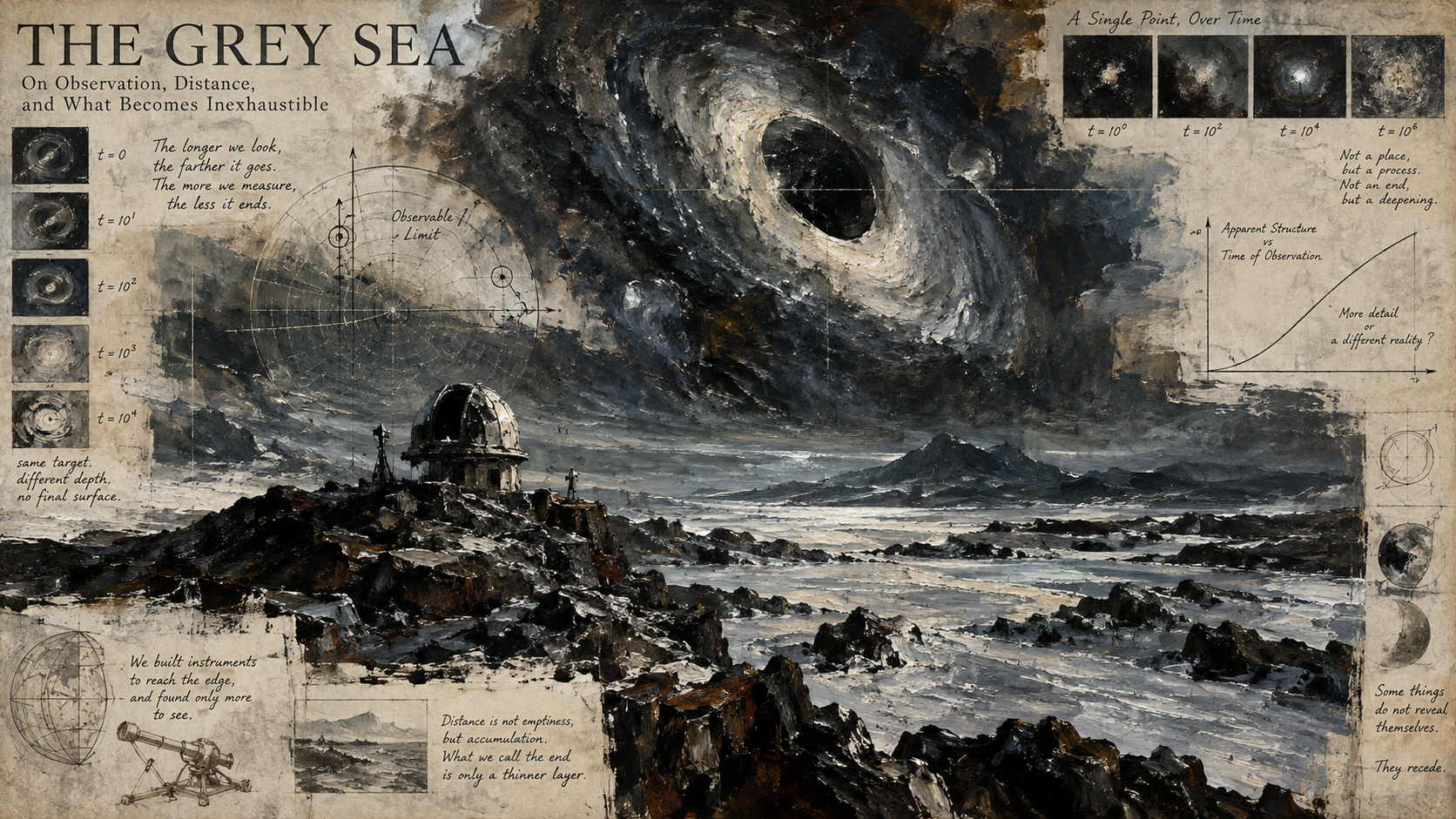
Human beings first saw the weather on an exoplanet clearly in the early twenty-third century. The planet lay forty-one light-years from the Solar System. It showed no sign of life, and most of its surface was covered by a dark ocean. Through twelve gravitational lenses distributed around the outer edge of the Solar System, people distinguished cloud bands, monsoons, and two polar caps that waxed and waned with the seasons. The project designated it HD 9446c. The media found the name difficult to remember and called it the Grey Sea.
The Grey Sea had begun as an ordinary research target. What changed everything was the thirty-seventh long exposure.
That observation captured a highly reflective band in the northern ocean, less than two kilometres wide but more than a thousand kilometres long. At first, some thought it was an unusually narrow cloud bank, but the spectrum was wrong. Then they proposed floating ice, but the temperature made that impossible. By the forty-first observation, the band had shifted, and its motion resembled no known ocean current.
The project received a second round of funding.
In the second year, they found three periodic heat sources at fourteen degrees south. In the third, the number rose to seven, two of which vanished simultaneously during a particular season. In the fifth year, an anomalous silicon isotope ratio appeared in the deep-ocean spectrum. In the sixth, researchers used the phrase “possible technological activity” in an internal report for the first time.
From then on, the Grey Sea was no longer a planet. It became an era.
Nearly every deep-space observation resource in the Solar System was rearranged. Telescopes grew more precise, the volume of data expanded, and new anomalies multiplied. Each solved mystery produced two finer questions. The original reflective band was eventually shown not to be a structure, but a floating layer of microcrystals formed by extreme salinity. Yet while explaining it, researchers discovered a previously unknown system of large-scale heat exchange below the surface. The system was not artificial, but displayed an extraordinarily stable geometric pattern. The pattern was later shown to arise from the planet’s rotation interacting with its ocean basins—except that the model also predicted some of those basins could not have been shaped by natural erosion.
Research on the Grey Sea continued for forty-six years.
When the first generation of scientists retired, their students took over. When those students retired, a third generation continued. A child could first encounter the Grey Sea in a primary-school textbook, enter the field as an adult, and reach fifty still explaining the same planet. It produced entire new branches of oceanography, complex-systems science, planetary geology, and signal analysis. Some people spent their careers studying a class of cloud vortices that lasted less than twenty minutes. One doctoral thesis discussed nothing but why an equatorial current deflected by 0.7 degrees at a particular latitude.
By the time Eileen Sato was born, the Grey Sea had already been observed for thirty-one years.
Her mother was a fourth-generation Grey Sea researcher who studied the deep-ocean silicon cycle. As a child, Eileen often heard her mother speak over dinner about an ocean forty-one light-years from Earth as though it were a distant relative. “The northern band came early again this year,” she would say, or, “They finally found the source of Anomaly 43,” in the same tone someone else might use to discuss an aunt they had not seen in years.
Eileen did not go on to study the Grey Sea. She trained in statistical physics and, after graduating, joined the Solar System Background Observation Centre. Her main responsibility was a kind of work few people wanted to do: deciding how anomalous the anomalies scientists saw actually were.
At thirty-six, she took part in an independent audit of the Grey Sea data.
The project was applying for the highest-priority observation time for the next twenty years. Its application ran to sixteen thousand pages and listed 271 unexplained phenomena. Eleven were assessed as possible biological activity. Three could not rule out a technological civilisation.
Eileen read for six months.
She found no fraud and no statistical error. On the contrary, the quality of the data was frighteningly good. The Grey Sea really was full of anomalies.
The problem lay elsewhere.
One evening, she reordered forty-six years of observation logs by cumulative viewing time and placed beside them the number of “new anomalies” registered each year. The two curves almost perfectly overlapped.
The longer the telescopes looked, the more anomalies they found.
There was nothing strange about that in itself. Close attention naturally reveals more detail. What was strange was that the growth never slowed. Scientific intuition suggested that as a system became better understood, its great mysteries should diminish, leaving ever finer questions behind. The Grey Sea did not behave that way. No matter how much the resolution improved, unexplained structures continued to appear at an almost constant rate.
She showed the chart to her colleague Malik. He looked at it for several minutes and said, “That proves it really is complex.”
“Or it proves that it is the only thing we have studied for this long.”
“What’s the difference?”
Eileen did not answer.
A few months later, she proposed an experiment in which almost nobody was interested.
An old telescope array at the edge of the Solar System had roughly two hundred hours of calibration time each year. Eileen requested that some of it be used for long-term observation of a random target. It could not be selected from existing data, and it could not be replaced after something interesting was found. A computer drew one planet from more than seventy thousand exoplanets that met the basic observational requirements.
K2-771b.
A small rocky planet sixty-three light-years from Earth.
It had only eleven hours of previous observations.
No atmospheric anomaly. No water. No unusual geology. Not even a media nickname.
After reading the target file, Malik said, “You intend to watch a rock for twenty years?”
Eileen said, “If it really is a rock, then in twenty years we will at least know one rock very well.”
Nothing happened in the first year.
The second was much the same.
In the third year, the observation team found that heat diffused near the day-night boundary at a rate slightly different from existing mineral models. The deviation was only 0.3 percent and was probably an instrumental error. Eileen insisted they continue.
In the fifth year, the deviation was still there.
Further observation suggested that the surface might be covered in a porous crystal with no natural counterpart in the Solar System. While studying the crystal, they found that heat flowed through the planet’s interior in a direction different from the one they had predicted. After reconstructing the internal structure, they discovered a possible solid-state mantle convection with a cycle lasting hundreds of years.
In the eighth year, someone completed the first doctoral thesis devoted entirely to K2-771b.
In the tenth, the media gave it a name.
The Stone Clock.
Inside the planet was an extremely slow but remarkably stable heat pulse, with a period of roughly forty-three years.
In the twelfth year, a team discovered that the so-called heat pulse was not a single cycle but the superposition of at least five different frequencies. They formed an exceptionally complex resonance that appeared to explain the unusual structure of the surface crystal.
By year fourteen, K2-771b had thirty-eight registered anomalies.
By year seventeen, it had 106.
It was beginning to look as unfathomable as the Grey Sea.
For the first time, the experiment caused a genuine controversy in the scientific community.
Some said the result was obvious. Every planet was a physical system with billions of years of history; of course it was complex enough. An “ordinary planet” was merely “a planet we have not examined carefully yet.”
Others argued that this was a substitution of concepts. The Grey Sea’s anomalies still included potential signs of life, while the Stone Clock was only geologically complex. The ability to generate many papers did not make them equally important.
Then someone asked a more uncomfortable question: what if they drew a second target?
So they drew another.
Then a third.
Eventually the targets were no longer limited to planets. They randomly observed a cloud of interstellar dust, an unremarkable comet, an object less than seven kilometres across at the edge of the Solar System, and even a region of thin plasma that had previously been treated as background noise.
After several years, the results began to seem absurd.
The small body produced an international collaboration devoted to particle migration in low gravity. The interstellar dust revealed a magnetic topology no one had seen before. The plasma region was initially believed to possess almost no internal structure; six years later, people were debating whether one of its faint oscillations represented an entirely new state of turbulence.
At a conference, Malik once said, “We may have discovered the most disappointing law in the universe.”
Someone asked what it was.
“Anything becomes a field if you stare at it long enough.”
The line spread and was printed on coffee mugs.
But Eileen found it less and less funny.
She began to revisit the history of the Grey Sea. Forty-six years earlier, why had it received the thirty-seventh long exposure? Not because anyone knew it concealed a secret. Another telescope had failed, the intended target had passed behind the Sun, and the scheduling program had selected the Grey Sea from a candidate list at short notice.
If that telescope had not broken, the thirty-seventh observation might never have happened.
The reflective band would not have been discovered.
There would have been no second round of funding.
No generations of researchers after it.
The Grey Sea would still be there, with exactly the same ocean, clouds, salt crystals, and deep-water structures. But in the human world, it would be a line of catalogue text.
The first time Eileen told her mother this conclusion, her mother was eighty-one and had been retired for years. Eileen expected her to feel that the research diminished her life’s work.
The old woman asked only, “So you think the Grey Sea isn’t important?”
“No,” Eileen said. “I think part of its importance is something we made.”
Her mother considered this. “What’s the difference?”
It was exactly the question Malik had asked seventeen years before.
This time, Eileen had an answer, but she did not give it at once.
Snow was falling outside. Her mother lived on the outskirts of Sapporo. In the yard stood a small pine planted after her husband’s death. Eileen had never looked at it closely. That day, she noticed that the trunk split in two half a metre above the ground. One side had grown distinctly thicker, and accumulated snow bent the finer branches into strange downward shapes.
Her mother followed her gaze. “That tree has gone crooked again this year.”
“Why is one side so thick?”
“I don’t know.”
They watched it for a while.
Then her mother explained that when the tree was first planted it had three main branches. Snow broke one during the first winter, so the remaining two had always been asymmetrical. The previous year, a family of starlings had nested there. The cat could not reach them because the branch on the right happened to block its path. Three years earlier, the tree had developed a fungal disease. She had thought it would die, but only the side closest to the wall was affected.
Listening, Eileen suddenly realised that the tree possessed a history she knew nothing about.
Of course, all trees did.
All houses did.
A stone on a table, if someone chose to study it for ten years, would have a mineral composition, a history of pressure, fracture lines, a place of origin, a journey, and a record of changing temperatures. A chair used for twenty years could produce an entire body of knowledge about bodies, wood, habits, and family life. Even a street corner someone passed every day without noticing would, once recorded, grow seasons, characters, sounds, repetitions, and accidents.
The world was not made of “things with stories” and “things without stories.”
It was made, rather, of places already illuminated and places not yet illuminated.
On the Grey Sea project’s sixtieth anniversary, the academic committee lowered its observation priority. Not because its questions had been answered—the opposite was true; more than four hundred phenomena remained unexplained. But telescope resources moved to a new allocation system in which fifteen percent would be permanently reserved for random targets.
The older generation of Grey Sea researchers was furious. They saw it as wasting valuable resources on a statistical experiment.
A young reporter interviewed Eileen and asked whether she believed the scientific community had devoted too much attention to the Grey Sea.
“Too much is a strange way to put it,” Eileen said. “Without that attention, we would not have modern exo-oceanography, and we would not know what complex fluid systems can do. The problem is not that we watched it for sixty years.”
“Then what is the problem?”
“We once believed that we kept watching because it was worth watching.”
The reporter waited.
Eileen said, “Sometimes the order may be the other way around.”
The interview was later cut into a short clip and widely shared. Many people understood it as a criticism of research funding. Others used it to discuss how the media manufactures celebrities, how markets manufacture value, and even why falling in love makes an ordinary person irreplaceable. Eileen had little objection to most of these applications. She only thought some of them were too neat.
What truly changed her life was something much smaller.
After her mother died, Eileen was responsible for clearing the house. In the bottom drawer of the study, she found more than forty notebooks of Grey Sea observations. Even after retiring, her mother had checked the public data every day and made handwritten notes about monsoon bands, ocean temperatures, and the anomalies she knew best.
The final notebook was only half filled.
Eileen sat on the floor and looked at it for a long time.
Of course she knew why her mother had kept watching. After someone had spent forty years gazing at a place, it was no longer merely an object of research. It held the people she had known when she was young, the hypotheses that had failed, the nights spent waiting for data at three in the morning, and countless details that had long since lost any scientific value.
That importance was not false.
It simply had not existed in advance.
Eileen took the notebooks home.
The following year, she requested no observation time for the Grey Sea. But on her personal terminal, she subscribed to the region her mother had watched most often. Occasionally, over breakfast, she opened the latest data for a few minutes. One year, the northern salt-crystal band shrank noticeably, and she looked up the relevant papers. Another time, nothing happened that was worth reporting, and she watched for a while anyway.
Meanwhile, she joined the Random Observation Committee. Every year, a computer drew several hundred targets from the universe for which no one had submitted a research proposal. Most looked profoundly dull at first. Some remained dull. But within the committee, the word “dull” gradually lost its former certainty, because no one was willing to guarantee that something would remain simple after twenty years of careful attention.
When Eileen was sixty-eight, the committee drew a low-mass star at the edge of the Orion Arm. It had no planets, no anomalous spectrum, no companion star, and not a single paper in the previous century had taken it as a subject.
The system asked for confirmation.
A newly arrived doctoral student looked over the file and laughed. “This time there really is nothing.”
Several older researchers in the room laughed too.
Eileen pressed confirm.
When the observation began, the screen displayed an entirely ordinary light curve.
No anomaly.
No signal.
Nothing happened.
At least, not on the first day.