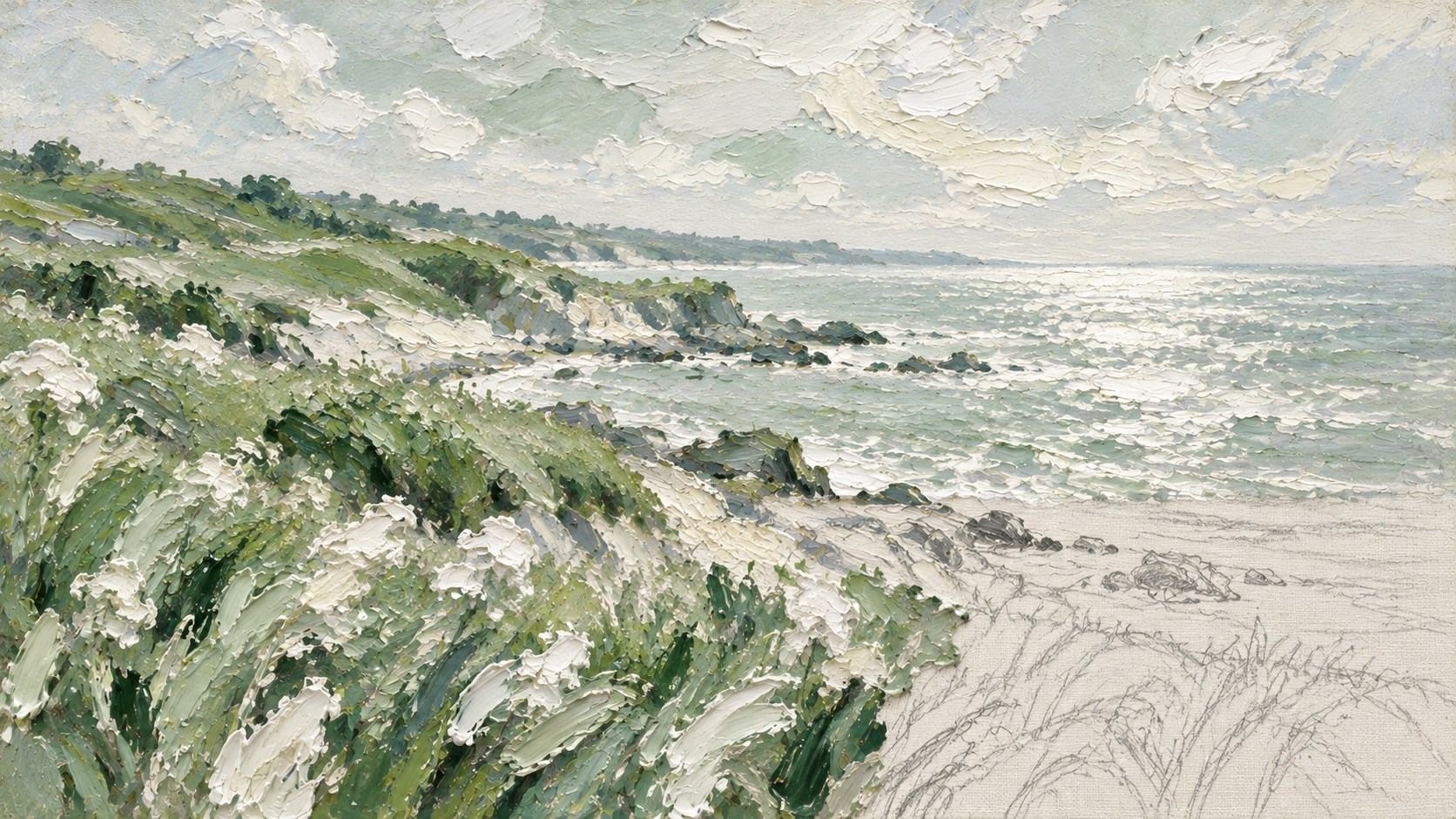
Six people at Vesper Laboratory stood around a screen, watching a coastline overgrown with wild grass. Evening was coming on. The gray-green meadow ran up to a low hill, and beyond the hill lay the sea. At first there was nothing remarkable about the image. Then Nico, the engineer running the demonstration, turned the viewpoint ninety degrees to the right. The hill slid off the left edge of the screen, and new terrain came into view: several pines bent by the wind, a shallow channel running toward the water, and two stones half buried in the grass.
Nico kept turning. More meadow appeared at the edge of the image, as though there were an entire landscape already there, waiting to be found. He moved the camera toward the hill, passed between the pines, circled a boulder, and followed the shore for almost three kilometers. There were no visible seams and none of the repeating textures that used to give away conventional game environments. Erin Voss, who was responsible for visual quality, leaned toward the screen and pointed out a problem with the shadows in one patch of grass. The sun was behind and to the right, but the grass leaned toward the right, as if lit from somewhere else. Nico opened the parameter panel, changed a few values, and the shadows settled into place. Erin picked up her cold coffee and asked him to take the camera back to where the demonstration had begun.
Nico retraced the coastline. The original stones were still there, as was the shallow channel. Only the pine that had forked into two main trunks now had three. Somebody laughed. Nico swore, froze the image, and asked the engineer in charge of long-range consistency whether the model had actually been updated. It had, the engineer said, but the branching structure of trees apparently needed additional constraints. He opened the logs to check. They argued about the tree for more than ten minutes before the person recording the demonstration reminded them that the investors had allowed eight minutes and were hardly going to ask anyone to turn the camera around.
Erin insisted that they fix it anyway. For two years she had seen too many gorgeous places that could not survive a second look. A generator could produce an astonishing mountain, a street full of flowers, or a bedroom holding the perfect afternoon light, but move the camera slightly and the mountain changed shape, another row of buildings appeared at the end of the street, or an extra window materialized in the bedroom. She had come to hate the way demonstration videos always eased forward, never allowing the viewer to see where they had just been. Now that they could finally turn back, she was not going to let one tree turn into three.
Four days later they had fixed it. Nico brought the camera to a stop in front of the pine and circled it seven or eight times. He moved so close to one branch that rough bark filled the image, then drew back. The branch was still pointing in the same direction. He raised the camera until the coastline became a thin, crooked line on a map, then plunged toward the ground, through the treetops and into a hollow behind the hill. The picture shuddered slightly, but the blades of grass did not rearrange themselves.
Someone finally applauded. Erin was watching the time in the corner of the screen. The demonstration had run for twenty-seven minutes, covered far more space than any earlier fixed environment, and never pushed the graphics hardware past its safe temperature. She saved the results under an unremarkable test name: Coastline 12.
Four months later, Coastline 12 had sound.
The first version was unbearable. The surf sounded equally loud at every distance, birds sang continuously in the forest, and wind from behind a hill could still be heard after the hill ought to have blocked it. The team spent two weeks on spatial acoustics and another week getting sounds to follow moving objects. The last troublesome case appeared in a generated country house. As a tester walked past the door, she heard crockery clatter inside. Curious, she pushed the door open and found a cup wobbling on a kitchen table, as if somebody had just knocked it. There was no one in the room.
She exited the scene and sent Nico the recording with a note: “Did you secretly add a ghost?”
Nico opened the world-state debugger instead of replying. The following day they ran the scene again. This time a man was sitting at the kitchen table, eating bread. His cup stood beside him, and he looked up when the tester came in. She asked what he was doing. He went on eating without answering. When she reached for the cup, the man vanished, taking the bread with him.
Three days later he could speak. He told her he lived in the house, that his wife had gone into town, and that lunch was not ready yet. The tester asked when his wife would be back. He gave an approximate time. At that hour footsteps sounded outside, and a woman carrying a basket came through the door.
The project manager was already preparing the footage for the next funding presentation when somebody discovered that the man failed to recognize the tester on her second visit. The demonstration was canceled. The team turned to long-term memory.
At first they only wanted generated people to retain elementary facts: names, occupations, homes, family members, and things a user had said to them. Within two weeks, a tester returned to a shop after three days away and the owner asked whether she still wanted the item she had been looking for. A few weeks later, characters began remembering things that had happened without any user present. A baker argued with his wife and was still refusing to speak to her several days later. An old man decided to sell his house; on the next visit, a notice was posted on the door. A child who could not ride a bicycle on one visit was cycling from one end of the street to the other several months later.
Quality assurance began to involve an odd new sort of work. Testers had to check for bugs, but they also had to drop in from time to time to see how people they knew were getting on.
In a coastal town assigned to Erin, there was a boat-repair shop. Its owner, Ada, was missing the little finger of her left hand and liked to take her tools outside when the sun was out. Erin once asked where she could rent a boat nearby. Ada recommended a little yard on the far side of the hill. The owner was bad-tempered, she said, but his prices were fair. Several weeks later Erin went to see her again. Ada was oiling a rusty metal box and asked, “Did you find a boat in the end? Last time you said you were hoping to go out over the weekend. I thought you'd at least come back to borrow some rope.”
Erin could not remember mentioning the weekend. She certainly remembered asking about boats, but not that. Ada reminded her that it had been raining that day, that they had talked for some time indoors, and that Erin had said she had never actually sailed a boat herself. Erin pulled up the old session record. Another tester had been using her account and had invented a little story about an upcoming sailing trip. Ada remembered it and had spent the intervening weeks keeping an eye out for a boat for a customer who might never return.
Erin asked whether the yard still had anything available. Ada shook her head. Business had been good lately, so it would be better to reserve in advance. As she spoke, she fished a nut out of her toolbox, realized it was the wrong size, and tossed it back. Erin nearly asked why a boatyard no user had ever visited should be doing such brisk trade. Instead she asked Ada to write down the address.
That afternoon she followed the path behind the hill. Seven boats were moored at the yard; one was being repaired, and the shore was cluttered with fishing nets and crates of spare parts. In the office a man was talking on the telephone. Three unpaid invoices lay on his desk. Erin stood outside for a while without going in, then exited the simulation.
Her test note read: “Offline agent behavior as expected. Cross-region memory synchronization stable.”
Six months later, world models could sustain hundreds of thousands of residents with occupations, property, persistent memories, and relationships with one another. Vesper no longer had time to test every environment by hand. There were so many releases each week that the engineers themselves could not keep track of them. Fixing a single tree's long-term consistency had once taken four days; now a model could often find its own mistake and generate corrective training data in half an hour. The company stopped staging launches for every upgrade. By the time the publicity materials were ready, the next version was usually better.
Game studios initially treated the technology as a cheaper way to make art assets. Then they realized it could replace much of the process of making a game. Developers no longer had to build each city in advance, write every side quest, or even decide which characters a player would encounter. They supplied initial conditions, defining geography, history, physical laws, and social structure, and let the rest unfold.
Someone created a Renaissance city-state governed by five rival families and watched it suffer two coups in three months. Someone else built an industrial civilization without metals to see what its people would use to lay railway tracks. A popular world consisted of a single island, an inn, and a couple of dozen inhabitants. Its users logged on every day to fish, until one update revealed that the innkeeper had divorced his wife and moved to the other side of the mountain to open a restaurant.
Virtual-reality headsets entered the picture almost without ceremony. The first generation still relied on external tracking. Turn too quickly and you became dizzy; reach the edge of a room and a warning appeared. Successive versions introduced complete spatial tracking, allowing users to crouch, run, swim, and reach down to stir mud in a river. Within a year, haptic suits were widespread. At first they merely vibrated where a character took a hit. Later they simulated temperature, pressure, friction, and water flow. One update made it possible to emerge from a virtual sea and feel your clothes gradually cool until wet fabric seemed to cling uncomfortably to your skin.
Erin first wore a complete haptic suit in an environment designed specifically to test seawater. She stood on a beach of coarse white sand, with a row of low houses bright in the afternoon sun. She walked into the water. At first only the tops of her feet felt cold; then, as the water rose, the suit began applying pressure to her calves and waist. As a wave receded, the sand seemed to loosen beneath her feet, leaving something gritty between her toes. She looked down for a long time, took a few more steps, and suddenly felt something rubbing against the side of her swimsuit.
She stopped and reached down, of course finding nothing. When she came out of the system, she asked which engineer had thought to add that detail. They searched for some time and found no one had designed it separately. The model had been trained on sensory recordings of real bodies at the beach. How it associated one kind of friction with one particular place had largely emerged on its own.
Erin rated the experience highly. In the comments she wrote: “Could reduce the amount of sand getting inside the swimsuit.”
Neural interfaces soon made even these devices obsolete. The first commercial brain-computer systems required bulky external hardware. Then the sensors shrank to thin patches worn on the scalp. Eventually, visual, auditory, and tactile information could be delivered directly to the nervous system. A cup in a game no longer needed to be rendered separately through a screen, headphones, and gloves. The user simply picked it up, felt its weight, smelled the coffee, and winced when a sip burned the tongue.
Only eleven months separated the release of the full haptic suit from the first direct neural experience. After that, they scarcely seemed to belong to the same industry.
By this point Erin had trouble explaining what it meant to enter a world. During one interface test, she woke in an unfamiliar bedroom. She knew it was generated and remembered the testing instructions perfectly, but it still took her several seconds to recall that her actual body was lying flat in a laboratory. Someone was calling out fruit prices beneath the window; a tram could be heard in the distance. When she got up to wash her face, the water was cold and the towel slightly stiff. In the mirror she looked three years younger than she was. She spent six hours completing her assigned tasks. When she returned, she remembered the stiff towel more vividly than any of the measurements in her test report.
Regulators began worrying about mixed memories. Some people spent five years in generated worlds only to return and discover that seven months had passed outside. Others insisted they had a spouse and children in another city, although those people existed only within a model scheduled for shutdown. Game companies introduced exit procedures, gradually restoring the sensations of the user's physical body or reminding them which memories belonged to the generated world.
A retired teacher sued one of Vesper's partner platforms over precisely this problem. He had spent three years running a small rural school in a generated world. Following a system migration, part of that world's history had been rewritten. He demanded that the school be restored to its original location and produced student essays, classroom photographs, and an invoice for repairs to the roof. The company's technicians repeatedly explained that all these records could be regenerated from backups. The teacher insisted that what needed restoring was a particular Wednesday afternoon, when he had promised one of his students that he would take the whole class to the river in spring.
The lawyer asked whether the teacher would be satisfied if the world were restored to an exact match. He considered this for a long time and said the student would also have to remember that the promise had been made.
The case was still in progress when the technology took another leap. Neural interfaces began using the user's own memories and sensations to generate the experience. The external model no longer had to supply a complete image of every object. Some experiments even found that the system could stop sending visual information altogether without diminishing the experience: high-level neural predictions alone allowed users to form a clear sense of space. Researchers deliberately removed half the scene data from one test. Nobody noticed. Some participants even described details that had never been generated in the first place.
Storage and computing costs fell rapidly. The worlds grew faster.
Soon a person needed only a few conditions to create a planet with a complete geological history and tens of billions of inhabitants. Conventional servers no longer had to store every small detail, but still had to maintain the state of countless interconnected events. A character changing jobs while the user was away could affect the economy of a city. A disease spreading through one village might alter the population of an entire continent decades later. Once something entered history, however minor, it might become the cause of something else.
The more complete a world became, the harder it was to remove any part of it.
The decisive advance in storage did not come from a computer company. A biological-computing startup proposed storing a world-generating program in synthetic DNA and letting neural tissue grown from it do the computing. The earliest experiments were concerned only with coaxing cells into particular computational structures. Researchers encoded a program in DNA, used it to grow a clump of neural tissue the size of a fingernail, and connected it to power and sensors. A few patches of color appeared on a screen. After two days, the patches began to maintain stable spatial relations; later there was a room, then a building, and eventually an outdoor landscape.
Initially the system was far less stable than conventional GPUs. Neural tissue could become diseased, stop functioning when the nutrient medium changed, or drift into strange cycles. On one occasion, the team discovered that a city inside the model had been living through the same day for three weeks, apparently without any of its residents noticing. The activity logs showed that a region responsible for updating long-term state had stopped developing, leaving only short-term prediction in operation.
But the system had an advantage that traditional computers could not easily reproduce. It did not need to store the particulars of every building, conversation, and stone. The cells only had to grow according to the initial architecture specified in the DNA. With continuing input and feedback, a model emerged, and the remaining complexity accumulated as it ran.
Eventually the team stopped trying to compress already trained models. Instead it searched for the shortest starting program that would allow the tissue to grow and reacquire similar capabilities. The sequence shrank from millions of bases to hundreds of thousands, then to fewer than a hundred thousand. Automated systems soon found new compression techniques almost every week. On one Friday the team celebrated a forty-percent reduction. By Monday morning another group had cut the model to a tenth of its previous size.
Vesper eventually acquired the biological-computing company.
They named the first biological computer capable of generating an entire world on its own ORIGIN. It was a fist-sized mass of neural tissue suspended in clear nutrient fluid and connected to external equipment through fine electrodes. Researchers did not feed it coastlines, cities, or people, only fundamental relations of space and time and a handful of physical constraints. For the first hours there was nothing on the screen but shifting noise. On the second day, matter began arranging itself into stable distributions. On the third, certain regions developed spatial structures that could be measured repeatedly. Within a week the researchers could trace something resembling weather cycles.
On the thirteenth day, monitoring systems identified the first organisms with persistent behavior.
By the third month, several stable ecological communities made up of different species had appeared.
Six months later, a settlement beside a river began putting up houses of stone.
Researchers argued almost daily over whether to intervene. Some wanted to introduce a tool and observe what the inhabitants did with it. Others wanted to alter the weather and test their response to disaster. Another group suggested running technological progress inside the model faster than outside, to get an early look at social problems yet to come. The ethics committee paid little attention at first, until a researcher testing flood defenses generated a flood directly over a densely populated area.
The subsequent report estimated that roughly seven thousand inhabitants had died.
The engineer responsible explained that the residents were not individually programmed people, but agents generated dynamically from the world state. No actual human being had been killed. The committee accepted part of that technical distinction but ruled that all large-scale interventions would henceforth require advance approval.
By the time Erin first stood before ORIGIN's cultivation chamber, several competing city-states had developed inside it. On a screen she could see the streets of a riverside city. Someone was repairing a roof in the distance, boats came and went at the docks, and an argument had broken out in the market. The simulation speed could be varied: a minute outside could contain a day within, or it could be slowed to match real time.
She asked the technician to set it to real time and watched for a while.
On a house by the river, a man was working on a loose section of roof. He struck it several times with a hammer, found that a plank was still lifting, put the hammer down, and crawled to the other side in search of something to support it. As Erin watched him shuffle the tools about, she thought of the boat-repair woman from years before. Her name had been Ada, perhaps, and she had been missing the little finger of her left hand. There was always a metal box of screws in her toolbox.
“If we cut the power now, what happens?” Erin asked.
The technician said the reserve supply could keep the tissue alive for seventy-two hours. Erin asked whether the inhabitants would notice anything in advance if they simply stopped feeding it. He showed her a termination report. Some models developed spatial instability; others stopped within a few milliseconds. They still had no reliable way of determining what, if anything, an observer inside would subjectively experience.
Erin asked nothing further.
One day, while checking the genetic data of organisms inside ORIGIN, Finn found a nondescript sequence that its DNA compiler could read directly. It encoded no protein and had no obvious regulatory function, yet its position was remarkably stable. He extracted it and loaded it into a blank biological computer to see what would happen.
Two days later the new model began producing stable physical structures.
On the third day Finn stopped the experiment and checked the input records. He had supplied none of ORIGIN's history and no data about species or environments, only a DNA segment extracted from an organism within it. Yet the new model had already formed a self-sustaining system of spatial and material relations.
He called Erin over and displayed the basic parameters of the two models side by side. They were not identical, but the similarities were startling. Erin asked whether the segment had come from ORIGIN's original startup program. Finn said it had not. He had excluded every known inherited component. Then he opened another set of results.
It was a sequence he had found in the human genome.
It worked too.
Erin examined the three sets of converging parameters and asked whether he had allowed the new model to develop further. Finn had. It was running in the next laboratory, he said. Complex life had not yet appeared, but the physical state was remarkably stable. Then he opened another comparison. ORIGIN's inner universe had already progressed much further. When life emerged on one of its planets, the same structure had appeared again in those organisms' DNA.
They did not publish immediately. Finn continued his experiments, while Erin applied to extend ORIGIN's runtime and let its civilizations develop. By then the model could run several centuries of internal history in a few hours outside. The researchers usually recorded large-scale events rather than following individuals. The planet with the early city-states passed through wars, migrations, and changes of climate, then industrialized and entered an age of electronic computing.
From there its progress accelerated sharply.
The team chose one advanced civilization for long-term observation. Its inhabitants built large computers and began training models that could predict their environments. The first systems generated images. Later they generated persistent spaces, sound, and people. The Vesper researchers followed the technical papers coming out of that civilization, sometimes recognizing the terminology immediately, sometimes having to consult the translation system because the other world had taken a different route.
Eventually that civilization began researching biological computation as well.
One morning Finn arrived at the lab to find that the overnight monitoring system had flagged a major technological event. A research institution within ORIGIN had succeeded in compressing the core of a large world model into synthetic DNA and growing neural tissue capable of generating an environment on its own.
He opened the recording.
On the screen was an ordinary-looking laboratory, its walls covered with diagrams, several people gathered around a transparent chamber. Their equipment looked strange, shaped by a different history of language and design, but the procedure was easy enough to follow. One researcher checked the nutrient fluid; another projected data onto a wall; somebody at the back stood drinking water.
The neural tissue in the chamber was running.
Finn requested its internal state. The system reported stable structures of time and space, with the first distributions of matter beginning to form. He accelerated observation and checked again several minutes later. Matter gathered into stars and planets. As the run continued, life appeared on some of those planets.
Erin came in around noon and found Finn still at the screen. She asked whether he had forgotten to eat again. He told her to look at something, then replayed the recording from the beginning. She watched for several minutes, asked him to stop where the researchers inside started their cultivation chamber, and had him place the two levels on the same timeline.
The screen was divided into three panels.
On the left was ORIGIN, inside Vesper Laboratory. In the middle was the world model cultivated by a civilization within ORIGIN. On the right was the young universe taking shape inside that new model. The three timelines ran at radically different speeds, but when Finn scaled them to comparable lengths, the gathering of matter, emergence of complex structures, and appearance of life followed an unsettlingly similar course.
Finn moved the right-hand timeline forward. Another civilization emerged, lived through its history, developed technology, and eventually began investigating more advanced systems of computation.
He offered no explanation.
Erin watched that generation of people go through their long series of experiments until they finally built a biological computer of their own. She asked Finn to switch the display to a text summary; it would save them from waiting for the high-resolution images to load every time. Finn opened the output settings and selected natural-language mode.
The screen turned white for a moment. Then a document window appeared.
Its first line slowly came into view.
“Six people at Vesper Laboratory stood around a screen, watching a coastline overgrown with wild grass.”